Tolkien's Dwarves as the Jewish Diaspora: Language, Exile, and the Return Home
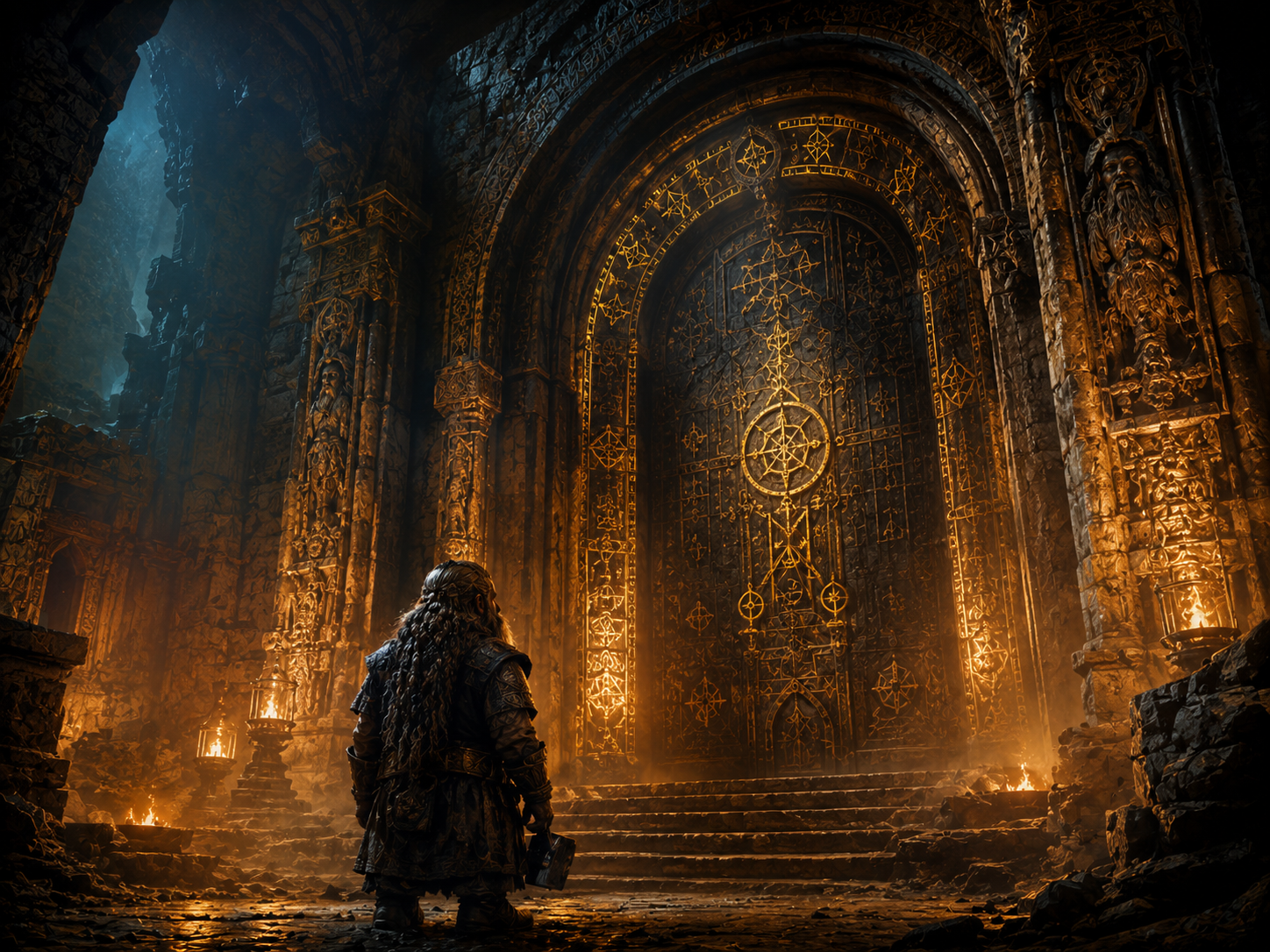
In 1955, responding to a question about the origins of his Dwarves, J.R.R. Tolkien wrote words that continue to spark debate among scholars of his work: "The dwarves of my books are, if you will, a kind of Jews." This admission is neither a casual remark nor evidence of the anti-Semitism of which the professor is sometimes accused. It is a key to understanding one of the most deeply conceived and carefully rendered peoples of Middle-earth.
A Semitic Language at the Heart of Fantasy
Tolkien was not merely a writer – he was a philologist. Every language in his legendarium had a deliberate linguistic foundation. The Elvish tongues – Quenya and Sindarin – drew inspiration from Finnish and Welsh. But when it came to Khuzdul, the secret language of the Dwarves, the professor turned to an entirely different linguistic family.
Khuzdul is built on a Semitic model. Its foundation is the triconsonantal root, exactly as in Hebrew and Arabic. Consider the root Kh-Z-D: from it derive Khazâd (Dwarves), Khuzdul (the Dwarvish tongue), Nulukkhizdîn (Nargothrond – "the Dwarven caves"). The same logic operates in Hebrew: the root K-T-V yields katav (he wrote), k'tov (write!), mikhtav (letter), katuv (written). Tolkien did not simply borrow individual words — he reproduced the very grammatical architecture of Semitic languages.
The phonetics of Khuzdul – guttural consonants, uvular sounds, an abundance of "kh," "z," and "d" – deliberately evoke the sound of Hebrew. Dwarves speak Westron (the Common Speech) with a characteristic accent, and Tolkien repeatedly noted their linguistic separateness: they learned the languages of their neighbors but never surrendered their own tongue to outsiders.
Lost Home and Perpetual Exile
The history of the Dwarves is a chronicle of loss. Their greatest kingdom, Khazad-dûm (Moria), was lost after the awakening of a Balrog. The Lonely Mountain, Erebor, was seized by the dragon Smaug. The Grey Mountains were abandoned under dragon assault. The Dwarves are constantly losing their homes and forced to wander.
Thorin Oakenshield speaks of this with a pain that cuts through every word:
We have never forgotten our grievance. Even now, when I am a king in exile, I remember that my kingdom has been taken and the treasure of my people stolen.
This is the language of galut. Jewish thought has lived for centuries in the tension between the memory of Zion and the reality of exile. The Dwarves' "longing for Erebor" is not a metaphor for nostalgia; it is a literal yearning to return to a lost homeland – a yearning sustained by maps, songs, and oral tradition passed down through generations.
Secret Names: A Jewish Parallel
The Dwarves of Middle-earth observe a custom strikingly reminiscent of Jewish tradition. Their true, secret names in Khuzdul are never revealed to outsiders. These names are never written down and never spoken in the presence of strangers. Even on their tombstones, only "outer" names are inscribed.
Jewish tradition maintains a similar practice: a child receives both a shem kodesh (sacred name, used in religious contexts) and a kinnui (everyday name). In Ashkenazi communities, a distinction between a public name and a secret Jewish name used in the synagogue persisted for centuries. Moreover, some communities maintain the custom of not disclosing a person's true name to non-Jews.
Tolkien takes this parallel to its logical conclusion: the Dwarves guard their inner world so fiercely that even in the Red Book – the primary source for The Lord of the Rings – their secret names go unrecorded.
The Gold Stereotype: Problem and Subversion
Honesty is required here. Tolkien's Dwarves love gold. They are master artisans, jewelers, and traders. The association of Dwarves with wealth inevitably evokes anti-Semitic stereotypes about Jews and money – stereotypes with a centuries-long history in European culture that led to catastrophic consequences.
Tolkien was undoubtedly aware of these stereotypes. But he did something crucial: he gave this love of gold a tragic dimension. Dwarven gold is not greed – it is a curse. The dragon-sickness that afflicts Thrór and later Thorin is a moral corruption born of excessive attachment to the material. Thorin overcomes it only at the moment of death, speaking his words of reconciliation to Bilbo – and in that moment of redemption, he becomes not a caricature but a tragic hero.
Moreover, Tolkien emphasizes that Dwarves are not mere hoarders. Their craftsmanship is an act of creation. They make beauty for beauty's sake. Recall the description of Khazad-dûm in its days of glory: halls carved from living stone, glowing crystals, mithril – a metal the Dwarves valued not merely for its worth but for its beauty and strength. This is not a miser crouching over a chest – it is an artist who has lost his studio.
"Baruk Khazâd!": A Battle Cry as Prayer
One of the most electrifying moments in The Lord of the Rings is the scene where Gimli, standing on the walls of the Hornburg, shouts the battle cry of his people: "Baruk Khazâd! Khazâd ai-mênu!" – "Axes of the Dwarves! The Dwarves are upon you!"
This cry is structured along lines closely resembling Jewish battle calls and proclamations: a brief, rhythmic exclamation in which the people name themselves, asserting their presence before the enemy. It sounds almost like "Am Yisrael chai!" – "The people of Israel live!" – a phrase in which collective identity becomes a weapon.
The linguistic parallel here is no accident. The rhythm, the syntax – a nominal construction followed by an assertion of presence – all reproduce the logic of Semitic exclamatory phrases.
The Return to Erebor: A Zionist Narrative
Thorin and his company's quest to the Lonely Mountain is, in essence, an aliyah. A group of Dwarves, scattered across the world and living among other peoples, gathers together to reclaim an ancestral homeland. They march not to conquer someone else's land – they are taking back their own, lost through violence.
The success of this return is no accident in Tolkien's moral universe. The Dwarves have a right to Erebor. Their claim is legitimate. And though they must fight in the process – including the Battle of Five Armies – the very structure of the narrative affirms: returning home is just and blessed.
Here Tolkien comes remarkably close to the Zionist idea. Just as the Jewish people returned to Palestine after two thousand years of exile, so the Dwarves return to Erebor guided by maps drawn generations earlier and songs their grandfathers sang. They did not assimilate. They preserved their memory.
After the victory, Dáin Ironfoot becomes King under the Mountain, and the Dwarven kingdom is restored. Thorin dies, but his sacrifice is the price of return, not the futility of the effort. Erebor belongs to the Dwarves once more.
Dwarves and Jews After Tolkien
It is worth tracing how the legacy of the Tolkien parallel lives on in contemporary culture. Peter Jackson, in his film trilogy, consciously amplified certain Jewish connotations: the makeup and facial features of the Dwarves, their speech patterns, even the visual design of Erebor – a fortress-city carved into rock, reminiscent of the Masada stronghold.
In Israeli culture, the parallel was noticed and embraced. Translations of Tolkien into Hebrew exist, including the legendary translation of The Lord of the Rings by Emanuel Lotem, in which the Dwarvish language is rendered with particular Semitic expressiveness. Israeli readers naturally read the Dwarves as "their own" – not as a caricature, but as a mirror of Jewish experience.
Conclusion: Honor, Not Caricature
Tolkien was a traditionalist Catholic and a man of his time. His letters contain formulations that sound awkward today. But his Dwarves are not an anti-Semitic caricature. They are a respectful, affectionate, and deeply artistic embodiment of a people the writer regarded with interest and sympathy.
Tolkien's Dwarves are keepers of a secret language, a lost home, and ancient traditions. They live in dispersion yet remain themselves. They speak foreign tongues but never forget their own. They fight and die for the right to return. This is not a stereotype. It is a portrait – perhaps the most poignant portrait of the Jewish diaspora ever written in the fantasy genre.
The history of how this portrait has been read is itself instructive. Generations of readers unfamiliar with the Jewish context saw Dwarves as simply amusing bearded warriors. But for those who know the taste of exile and the cost of preserving identity among strangers, Tolkien's Dwarves sound different. They sound familiar. And in that – the highest tribute one people can pay another through art.
Sources
- Tolkien, J.R.R. The Letters of J.R.R. Tolkien. Letter 176 (to Naomi Mitchison, December 1955). Houghton Mifflin, 1981.
- Tolkien, J.R.R. The Peoples of Middle-earth. Edited by Christopher Tolkien. HarperCollins, 1996. – Appendix on Dwarvish language structure and Semitic roots.
- Fimi, Dimitra. Tolkien, Race and Cultural History: From Fairies to Hobbits. Palgrave Macmillan, 2009. – Chapter 6: "Dwarves, Jews, and the Languages of Middle-earth."
- Rateliff, John D. The History of The Hobbit. HarperCollins, 2007. – Analysis of the Dwarves' characterization and development across drafts.
- Zettersten, Arne. J.R.R. Tolkien's Double Worlds and Creative Process: Language and Life. Palgrave Macmillan, 2011. – Discussion of Semitic influence on Khuzdul.
- Shippey, Tom. The Road to Middle-earth. HarperCollins, 2005. – Chapter on language invention and the philological foundations of Tolkien's races.
- Lotem, Emanuel (trans.). שר הטבעות (The Lord of the Rings, Hebrew edition). Zmora-Bitan, 1998. – The standard Hebrew translation preserving Semitic linguistic textures.
- Brackmann, Rebecca. "Dwarves Are Not Heroes: Antisemitism and the Dwarves in J.R.R. Tolkien's Writing." Mythlore, vol. 28, no. 3/4, 2010. – Critical analysis of the Jewish-Dwarf connection.
- Vink, Renée. "Jewish' Dwarves: Tolkien and Anti-Semitic Stereotyping." Tolkien Studies, vol. 10, 2013, pp. 123–145. – Nuanced examination of stereotype and subversion.
- Kallay, Katarzyna. "The Theme of Exile and Return in Tolkien's Legendarium." The Inklings and Culture, Cambridge Scholars, 2020. – Parallels between Dwarven exile and diasporic experience.