The Jewish Code of Harry Potter: Golems, Blood, and Kabbalah
In 1997, the first book about a boy wizard was published. Twenty-seven years later, the saga has sold over 600 million copies. But beneath the broomsticks, spells, and Quidditch lies a layer of meaning almost nobody talks about.
Rowling has repeatedly pointed to Christian allegory: death and resurrection, sacrificial love. But the roots of these allegories run deeper – into Judaism. Not metaphorical Judaism, but the concrete kind: kabbalistic sefirot, golems, and talmudic concepts of time.
I'm not claiming Rowling planned this. But texts are often smarter than their authors. Let's dig in.
Blood Purity: The Nuremberg Laws in a Wizard's Robe
Wizards are divided into pure-bloods, half-bloods, and Muggle-borns. The latter are contemptuously called "Mudbloods."
This classification reproduces the 1935 Nuremberg Race Laws almost verbatim. There, "Jewishness" was determined by grandparents. Here – by the same logic.
Voldemort's regime in the seventh book is a carbon copy of Nazi Germany:
- The Ministry of Magic becomes a collaborationist government
- A Muggle-Born Registration Commission mirrors racial hygiene departments
- Rhetoric of "blood contamination" and "blood traitors" is a direct echo of antisemitic propaganda
Rowling was born in 1965 and grew up in a Britain where Holocaust memory was part of public consciousness. The anti-fascist message is deliberate.
But here's the uncomfortable question.
The Goblins of Gringotts: The Elephant in the Vault
Goblins in Harry Potter are short creatures with hooked noses, long fingers, and exceptional banking talent. They run Gringotts – the only bank of the wizarding world.
This image reproduces antisemitic caricatures that circulated in European culture for centuries: from Shakespeare's Shylock to Der Stürmer illustrations. Hooked nose, gold-lust, financial control – the classic triptych.
In December 2021, Jon Stewart, on his podcast The Problem with Jon Stewart (Apple TV+), compared the film goblins to illustrations from The Protocols of the Elders of Zion. He later clarified he wasn't calling Rowling antisemitic – just pointing out that some tropes are "so embedded in society that they're basically invisible even in a considered process like moviemaking."
Rowling defended herself: goblins are folklore, nothing more. The parallel still stings.
Set aside the visuals, though. The goblins have a complex culture, a legal system, and dignity. Their conflict with wizards is the classic minority dilemma: stay separate or assimilate, and at what cost.
Here's a contrast. In 2014, Rowling confirmed on Twitter that Hogwarts has at least one Jewish wizard: Anthony Goldstein, Ravenclaw student and Dumbledore's Army member. The surname speaks for itself. Unlike the goblins, Anthony is an ordinary student – not a single stereotypical trait. The contrast is telling.
House-Elves: The Golems of Hogwarts
House-elves are created for service. They're bound to a house or family and can't disobey. Their magic is powerful but constrained by subjugation.
This is an almost verbatim description of the golem from Jewish tradition.
The golem is an anthropomorphic clay being, animated by the mystical power of Hebrew letters. The most famous legend: the Prague golem, created by Rabbi Judah Loew ben Bezalel (the Maharal) in the 16th century to protect the Jewish quarter from pogroms. The golem has no will – it executes commands literally and completely.
Dobby is a golem who acquires free will. His liberation through Lucius Malfoy's sock is the granting of a soul to a soulless being. His tombstone – "Here Lies Dobby, a Free Elf" – is a midrash about a created being that transcended its creator.
Lily's Sacrifice: A Kabbalistic Protective Circle
Lily Potter's death is the saga's central event. She protects her son with her life, creating a magical barrier Voldemort cannot cross.
Christian reading: Christ allegory. Jewish reading: kabbalistic protective circle through self-sacrifice.
In Jewish mysticism, blood carries the nefesh (animal soul). The voluntary shedding of a righteous person's blood creates a powerful spiritual barrier. Lily's protection works exactly this way: an invisible circle around Harry, impenetrable to his enemy.
Moreover, the protection extends to the Dursleys' home until Harry comes of age. An almost eruv – the symbolic enclosure extending private space boundaries in Jewish law.
The Deathly Hallows and the Tree of Sefirot
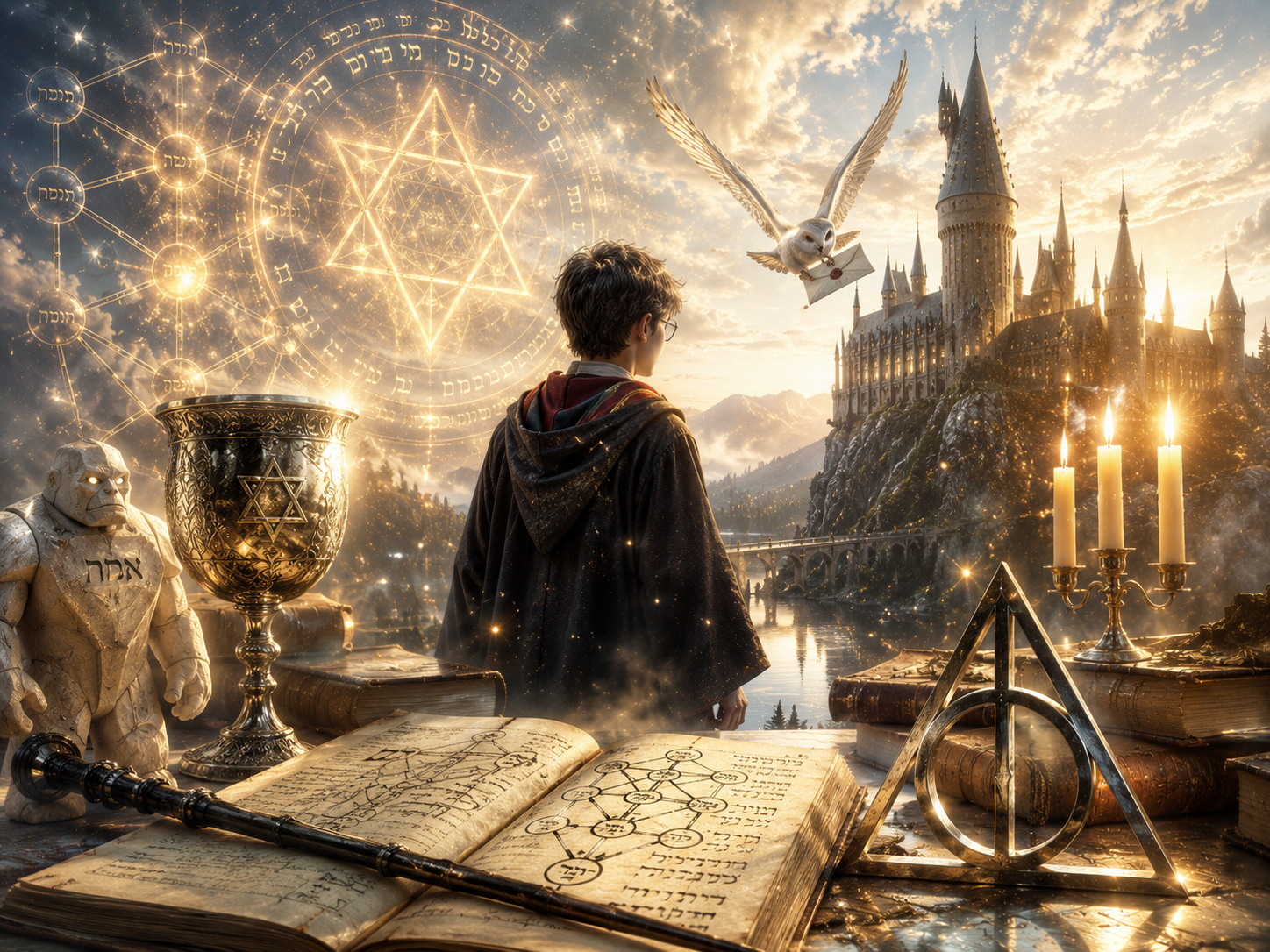
Three Deathly Hallows: the Elder Wand, the Resurrection Stone, and the Cloak of Invisibility. In Jewish mysticism, the Tree of Sefirot has ten divine emanations. The three highest: Keter (Crown), Chokhmah (Wisdom), Binah (Understanding).
How they map:
- Elder Wand → Keter. The highest sefirah, will and sovereignty. The unbeatable weapon, mastery over death.
- Resurrection Stone → Chokhmah. Primordial wisdom, the point from which all existence arises. Summons the dead as shadows.
- Cloak of Invisibility → Binah. Understanding, associated with concealment and revelation. Hides from Death itself.
Legend says whoever unites all three becomes "Master of Death." Harry renounces this. He drops the Stone in the Forbidden Forest, leaves the Wand in Dumbledore's tomb, and keeps only the Cloak – the gift passed down from his father.
This is a Jewish gesture: rejecting power over death in favor of life. Victory lies not in domination but in the chain of generations. L'dor va-dor – from generation to generation.
Horcruxes: Voldemort's Shevirat Ha-Kelim
Voldemort creates Horcruxes – soul-fragment vessels – to achieve immortality. He intended seven soul pieces (six Horcruxes + body). He ended up creating seven Horcruxes – Harry became the eighth, unintended fragment.
Jewish anthropology distinguishes several soul levels: nefesh (animal soul), ruach (spirit), neshama (higher soul). All are given as a unified gift. Splitting the soul is an ontological catastrophe.
In Kabbalah, this is called shevirat ha-kelim – the breaking of the vessels. The primordial cosmic catastrophe humanity is called to repair (tikkun), not worsen. Voldemort does the opposite: he deliberately shatters his own soul.
His final state – a shriveled creature on the floor of King's Cross – visualizes the klipot: shells of evil, empty husks after divine light has departed.
Harry preserves his soul's integrity even while carrying Voldemort's fragment. That wholeness is what lets him win.
Platform 9¾: The Space of Bein Ha-Shmashot
Every September 1st, Harry passes through a wall between platforms 9 and 10. Platform 9¾: neither here nor there, neither real nor imaginary.
This is a precise match for the talmudic concept of bein ha-shmashot – "between the suns." The twilight between sunset and stars: neither day nor night, neither weekday nor Sabbath. Boundaries between worlds grow thin.
According to the Mishnah (Avot 5:6), it was during bein ha-shmashot that special things were created – things outside ordinary creation: the mouth of the earth that swallowed Korach, Balaam's donkey, and other wonders.
Platform 9¾ works the same way: Muggle-world laws stop, magic begins. To pass through, you must know and believe – echoing the Jewish emunah (faith-trust) that itself creates reality.
In the finale, King's Cross becomes the meeting place between life and death – the purest bein ha-shmashot, a space of choice.
Death and Return: The Jewish Roots of a "Christian" Allegory
Rowling called Harry's sacrifice a Christian allegory. But the structure is rooted in Jewish theology.
The idea that a righteous person's death atones for others – mitat tzadikim mechaperet – is Jewish (Moed Katan 28a). The Binding of Isaac (Akedah) is the primal narrative: a son on the altar, replaced by a ram at the last moment. This is the Jewish foundation Christian theology later built upon.
Harry is Isaac who becomes the ram. He offers himself, and the sacrifice protects everyone he loves – just as Lily's sacrifice protected him.
And his return happens in a forest. Not a temple, not a tomb – wild space. This echoes the Jewish understanding of holiness: unbound to place, manifesting wherever a person performs an act of faith.
Harry builds no church. He returns, marries, raises children. An ending far closer to the Jewish ethos of life's continuity than to the Christian drama of salvation through death.
Sources
- Rowling, J.K. Harry Potter. Bloomsbury, 1997–2007. Seven volumes.
- Scholem, Gershom. Major Trends in Jewish Mysticism. Schocken Books, 1941.
- Idel, Moshe. Golem: Jewish Magical and Mystical Traditions on the Artificial Anthropoid. SUNY Press, 1990.
- Babylonian Talmud, Tractate Shabbat 34b (on bein ha-shmashot).
- Mishnah, Avot 5:6 (on twilight creations).
- Babylonian Talmud, Moed Katan 28a (on mitat tzadikim mechaperet).
- Nuremberg Race Laws, Reich Citizenship Law, September 15, 1935.
- Stewart, Jon. Harry Potter goblins episode – The Problem with Jon Stewart, Apple TV+, December 2021.
- Stewart, Jon. Follow-up video clarifying he was joking – Twitter/X, January 2022.
- "Jon Stewart backtracks, says he was joking when calling 'Harry Potter' goblins antisemitic" – The Jerusalem Post, Jan 6, 2022.
- "J.K. Rowling Confirms: There Are Jewish Wizards" – TIME, Dec 17, 2014. Rowling confirms Anthony Goldstein as a Jewish wizard.
- Kaplan, Aryeh. Inner Space: Introduction to Kabbalah, Meditation and Prophecy. Moznaim, 1990.
- Rosenberg, Yudl. The Golem and the Wondrous Deeds of the Maharal of Prague. Yale University Press, 2007.
- Green, Arthur. These Are the Words: A Vocabulary of Jewish Spiritual Life. Jewish Lights Publishing, 1999.
- Luria, Isaac (the Ari). Teachings on tzimtzum, shevirat ha-kelim, and tikkun – recorded by Chaim Vital, Etz Chaim.