
Between Faith and Roots: The Cultural Crisis of Central Asian Muslims
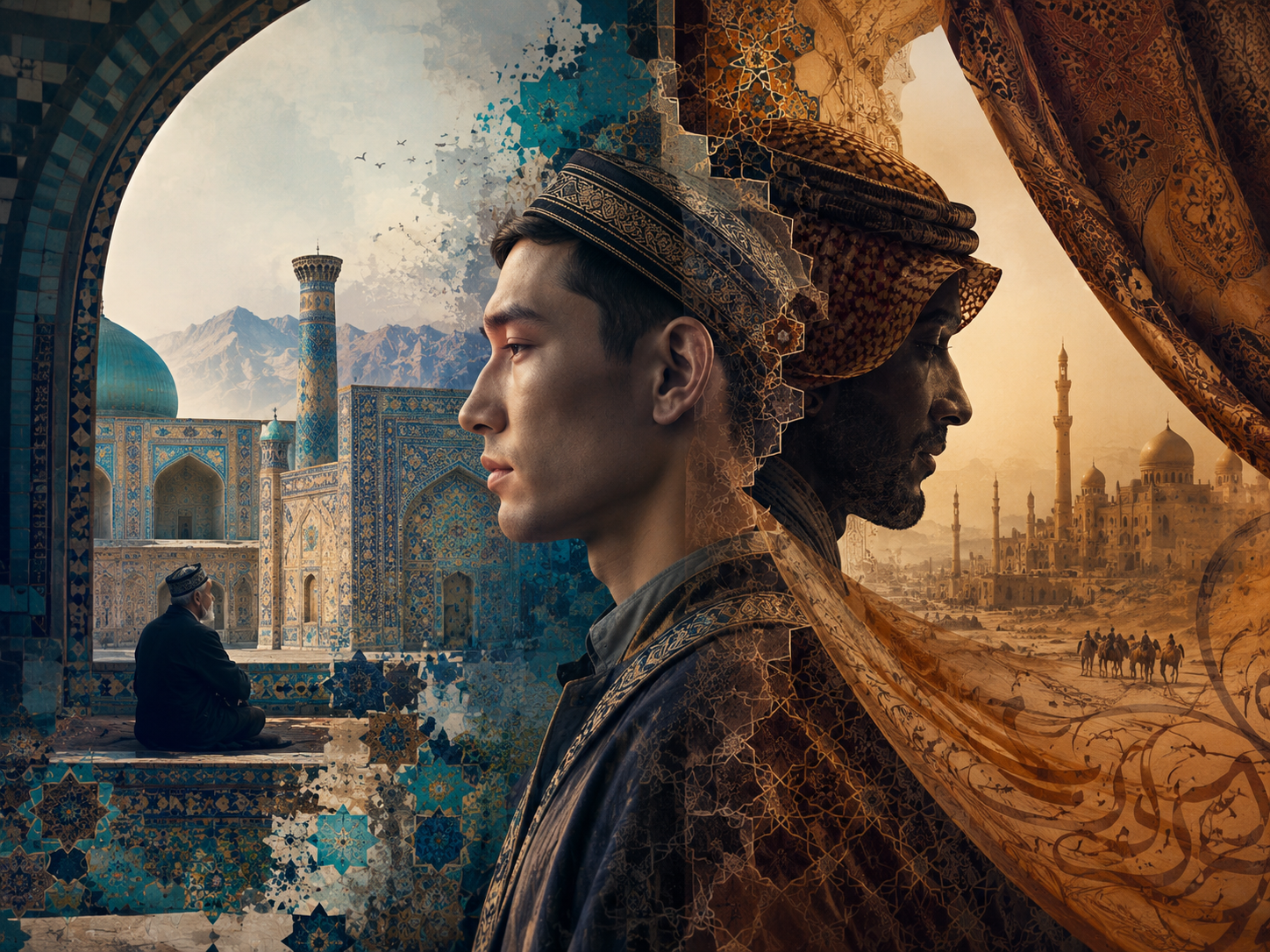
Between Faith and Roots: What Are Central Asian Muslims Forgetting?
In literature, there is a terrifying and profound concept—the mankurt. A mankurt is a person stripped of their historical memory; the ultimate, perfect slave. He does not remember where he came from, the language of his ancestors, the taste of his native food, or the joy of his national holidays. Having lost his roots, he easily and even gratefully adopts the language, traditions, and culture of his new master.
Today, many Muslims in Central Asia face a complex and often uncomfortable question: where is the fine line between sincere faith in God and complete assimilation into a foreign culture?
Sunnah or 7th-Century Arab Culture?
For many believers, the Sunnah is the detailed life path of Prophet Muhammad (PBUH), serving as the foundation of fiqh**(Islamic jurisprudence)** and daily life. But if we look closer, how much of this is truly spiritual, and how much is strictly cultural, rooted in Bedouin lifestyle?
Along with religion, the daily routine of the 7th-century Arabian Peninsula has firmly embedded itself into the lives of modern Central Asians:
- Language and Prayer: Five times a day, you turn your gaze toward Arabia, addressing the Almighty exclusively in the Arabic language.
- Appearance and Fashion: You learn the "correct" way to trim a mustache and grow a beard, while your fashion choices are dictated by styles historically born out of a desert climate.
- Dietary Habits: You strive to break your fast with Ajwa dates and drink talbina, scouring the markets of Kazakhstan, Uzbekistan, or Kyrgyzstan to find them—even though these foods never grew there and were never part of your traditional diet.
Gradually, step by step, foreign holidays replace your own, and a foreign culture begins to be perceived as the only true and sacred one.
The Dogma of Superiority: The Place of the "Ajam" in the Islamic World
Historically, Islamic theological thought has not always been unanimous on the equality of nations. The renowned Sunni theologian Ibn Taymiyyah, in his book "Iqtida' as-Sirat al-Mustaqim" (The Requirement of the Straight Path), explicitly wrote about the superiority of Arabs over the "Ajam" (non-Arab peoples, including Turkic and Persian populations). According to this view, the Arab lineage is inherently the best among human lineages, and within it, the Quraysh are the elite.
This concept relies on hadiths (particularly from the collection of At-Tirmidhi), which state that the Almighty placed the Prophet in the best of groups, the best of tribes, and the best of lineages.
The political consequences of this theology were very real. In classical Islamic law, the Ajam were historically denied the right to become the Caliph. Both Sahih al-Bukhari and Sahih Muslim cite traditions asserting that authority and the right to rule belong exclusively to the Quraysh tribe.
The Price of Conquest: How Islam Came to Transoxiana (Mawara al-Nahr)
When looking back at the Islamization of Central Asia, it is crucial to read primary sources—such as the chronicles of At-Tabari—with open eyes. The arrival of the new religion was not always a peaceful philosophical debate.
The history of the conquests begins in Merv (modern-day Turkmenistan), from where Arab armies crossed the Amu Darya river, advancing toward Nasaf (Karshi) and Paykand (Bukhara region).
- From the outskirts of Bukhara, 2,000 skilled archers were enslaved and taken as spoils of war (ghanima).
- In Samarkand, fifty noble youths were taken as hostages. Despite agreements promising their return, they were transported via Termez to Medina, and their traces were forever lost to history.
The Illusion of "Returning to Roots"
Today, on the streets of our cities, we witness a striking phenomenon: young women across Central Asia are increasingly donning strict, sometimes fully concealing black garments, sincerely believing they are doing a righteous deed by "returning to their roots." But we must ask ourselves an honest question: whose roots are they returning to?
The historical clothing of Kazakh, Kyrgyz, Uzbek, Turkmen, and Tajik women has always been defined by its vibrancy, incredible color palettes, and practical adaptation to our way of life. By wrapping themselves in black fabrics—styles dictated by the harsh climate and rigid tribal structures of the 7th-century Arabian desert—many of our contemporaries are erasing the history of their own land.
We forget how exactly these aesthetics and rules became "ours." As the chronicles of At-Tabari impartially document, the Muslim expansion into Mawara al-Nahr was not solely a peaceful spiritual exchange. It carved its path through conquest, the enslavement of thousands of skilled Bukharan artisans, and the vanishing of Samarkand hostages in Medinan dungeons. This culture came to us as the culture of the conquerors, imposed upon the conquered.
The substitution of concepts is the most dangerous and subtle step toward becoming that very mankurt. To confuse Arab cultural and political expansion with the true roots of our ancestors means erasing our own history. For modern people, it is more important than ever to look truth in the eye, acknowledge the uncomfortable facts of our past, and separate the universal spiritual values of faith from an imposed foreign cultural code.
Follow Gaza Bubble on social media—here, we step outside the boundaries of illusion.